
Baby knit sets
Top and pant in combed cotton, envelope necks, no loose buttons under size 12M.
Knit and woven sets for babies and kids, plus school uniform programmes — safety paperwork and uniform durability done properly for your destination market, from 100 pieces.
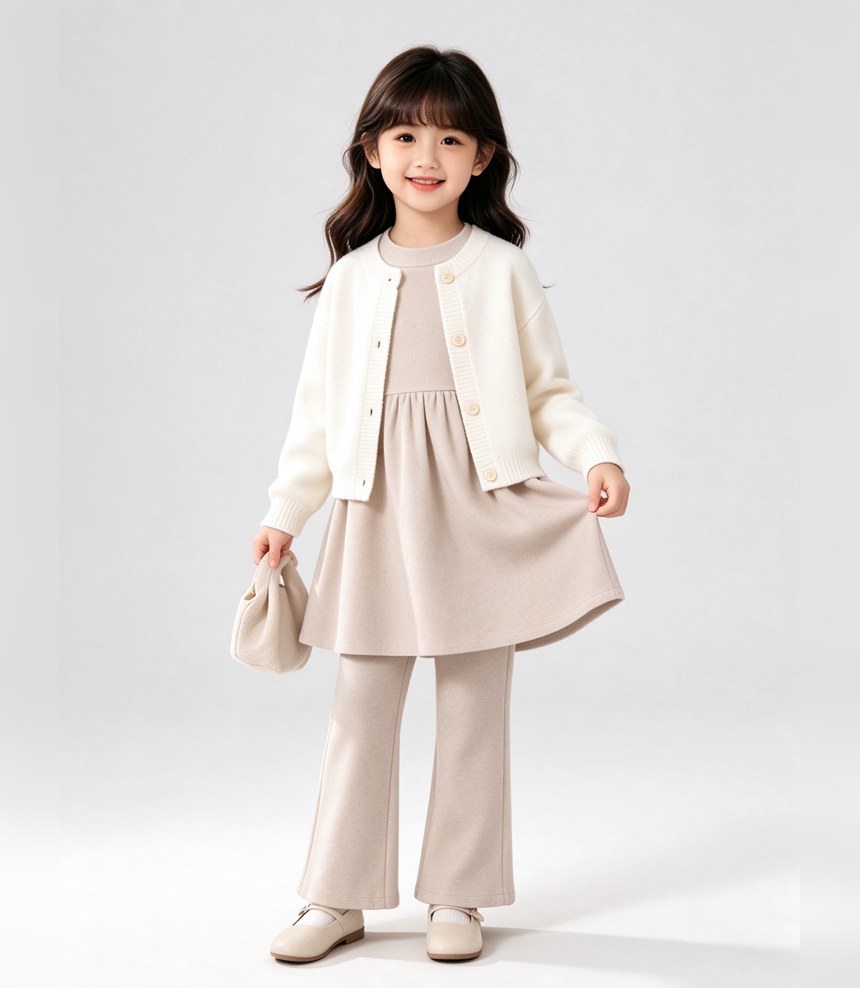
Common variants on the same block, all adjustable to your tech pack.
Top and pant in combed cotton, envelope necks, no loose buttons under size 12M.
Everyday programme in 2–8 years; growth room built into the block, not into sizing noise.
Poplin shirts, occasion dresses; snaps and zips specified to avoid pinch points.
Brushed fleece sets, the Q4-weighted line for kids too.
Padded jackets with safe detachable-hood rules — cords and drawstrings are regulated on children's wear.
Shirt plus trousers or skirt, with an optional blazer and knit cardigan. School colours, badge placement and class coding handled in one spec; poly-cotton blends chosen for wash-and-wear through a full school year.
Usual fabrics for this category — or your nominated or customer-supplied material.
| Fabric | Composition | Weight | Suits |
|---|---|---|---|
| Combed cotton jersey | 100% cotton, bio-washed | 180–220 GSM | Tees, sets |
| Cotton-spandex | 95% cotton / 5% spandex | 200–240 GSM | Leggings |
| Cotton poplin | 100% cotton | 110–130 GSM | Shirts, dresses |
| Poly-cotton uniform twill | 65% polyester / 35% cotton | 180–240 GSM | School shirts, trousers, skirts |
| Brushed fleece | 100% cotton | 280–320 GSM | Loungewear |
| Padded nylon | Nylon shell, recycled fill | 60–90 GSM shell | Outerwear |
Private label, print, embroidery and special finishes handled inside one order.
No loose buttons below 12M, no drawcords at the hood on kids' outerwear (EN 14682 / 16 CFR 1120). We design to the rules, not around them.
Snaps, zips and prints tested for lead and phthalates per destination market; reports ship with the order.
Flatlock or covered seams against skin; kids' wear is judged on whether it gets worn twice.
Care, fibre and tracking labels per market; size labelling in months/years rather than a single size code.
Embroidered or heat-transfer crests and class colour coding, placed to your artwork. Uniform programmes are usually ordered summer and winter, so the badge spec and thread colours are archived for reorder.
How a full uniform set is developed, from grading to delivery

Kidswear sells by height, not S/M/L — mainstream tiers mapped to body data.
| Size | Height | Weight | Age |
|---|---|---|---|
| 90 | 85–95 cm | 10–13 kg | 1.5–3 yrs |
| 110 | 105–115 cm | 15–19 kg | 4–6 yrs |
| 130 | 125–135 cm | 22–28 kg | 7–9 yrs |
| 150 | 145–155 cm | 32–42 kg | 10–12 yrs |
Full size runs are costly — first order focuses on 110 and 130 (the most active purchase decision band around school age), then widen.
Safety items are hard red lines in kidswear — checked item by item before shipping; any failure blocks shipment.
| Check | Standard | Method | On failure |
|---|---|---|---|
| Head/neck drawcords | No cords at head/neck under age 7 | Visual + measure | Switch to snap panel or shorten design |
| Button pull strength | ≥70 N without release | Pull gauge | Double-lock or change to snaps |
| Formaldehyde / pH | GB 31701 Class A | Lab test | Re-select fabric or supplier |
| Sharp edges | No burrs, no broken needles | Needle detector + manual | Rework |
Every kidswear order passes the needle detector by default with batch records kept; Class A test reports ship with the bulk.
Design details that work on adult wear need safe equivalents on kids — use this table directly.
| Adult design | Kids substitute | Reason | Age |
|---|---|---|---|
| Long hood cords | Velcro hood panel | Anti-entanglement | All ages |
| Beaded sequins | Embroidery or heat-set motif | Anti-ingestion | Mandatory under 3 |
| Metal D-ring trim | Webbing loop / print | Anti-scratch | All ages |
| Small metal zip pull | Silicone or fabric pull | Anti-ingestion breakage | Mandatory under 3 |
We review the trim list by age band at design sampling, flagging what cannot be used before a single sample is cut.
Two reasons: safety-tested trims are bought in batches, and kids' size ranges (12M–8Y) split any order across six or more sizes. 100 pieces is the smallest run that stays economical across a size run.
Trim test reports (lead, phthalates, cadmium), flammability for fleece where applicable, and fabric composition certificates. We ask your destination market at briefing stage, because the rules differ.
Yes, with GOTS-certified fabric lots and chain-of-custody documentation. Note the fabric carries a price premium; the dye house runs solid-colour lots from roughly a 300-piece quantity, while garment orders still start at 100 pieces per style.
Months for baby (3M–24M), years for children (2Y–8Y), and they do not map one-to-one between EU, US and UK blocks. We provide a conversion table with the quote.
Yes — shirts, trousers or skirts, blazers and knit cardigans under one spec. Uniform orders are graded across the full student size run (usually 3Y–16Y), packed per class or per campus, and the badge and trim spec is archived so the winter order matches the summer one. MOQ applies per style per colour, not per size.
Send your reference — pricing and a sampling plan within 24 hours.
Want the whole range in one file? Download the 2026 catalogue (PDF, 32 categories).
Send a sketch, a sample or just an idea — we reply within 24 hours with MOQ, pricing and sampling advice.