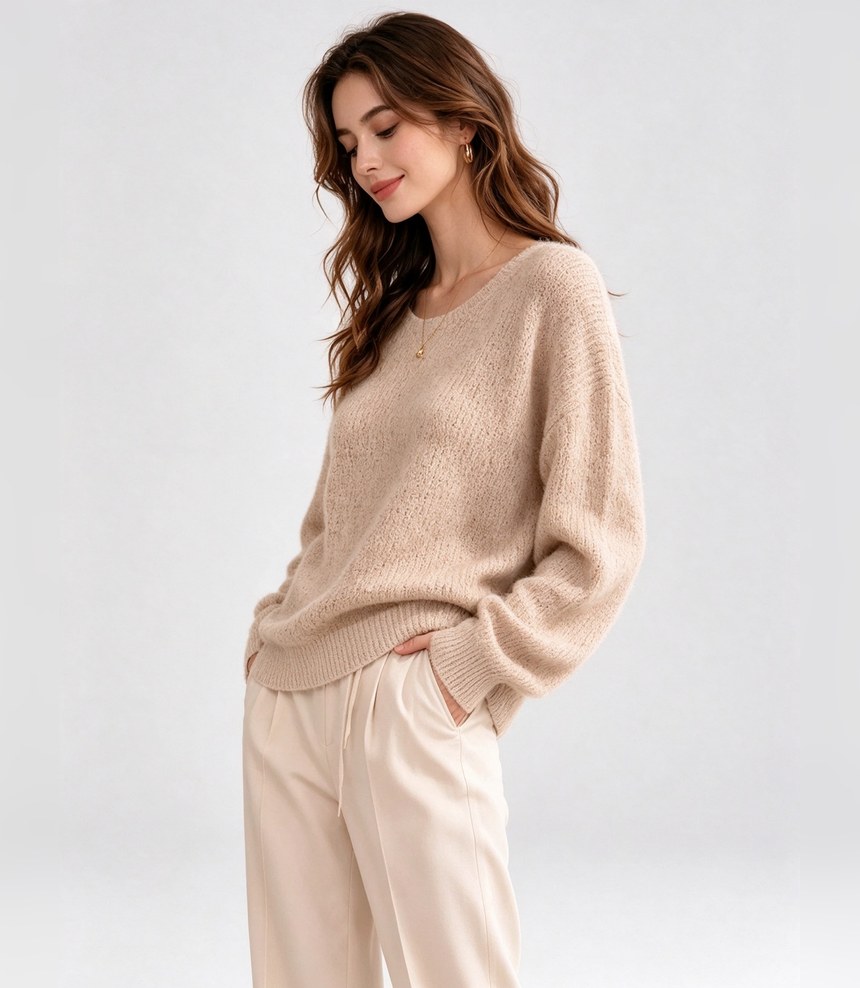
Crew neck pullover
Set-in or raglan sleeve; the base style for most programmes.
Flat-knit sweaters, cardigans and knit tops from 100 pieces — 3 to 12 gauge, wool, cashmere blends and cotton, with cable, jacquard and garment wash.
Common variants on the same block, all adjustable to your tech pack.
Set-in or raglan sleeve; the base style for most programmes.
Button placket, rib bands; button quality decides perceived value.
Cable width and repeat drive yarn consumption — quote after the swatch.
Colour work; each additional colour raises minimums and lead time.
Neck height and recovery are the failure points.
Fine gauge 12GG, worn as a layer; lighter and cheaper than a sweater.
Usual fabrics for this category — or your nominated or customer-supplied material.
| Yarn | Composition | Gauge | Character |
|---|---|---|---|
| Merino wool | 100% merino | 12GG / 7GG | Soft, fine, good for premium basics |
| Cashmere blend | 30% cashmere / 70% wool | 12GG | Luxury hand; costs 2–3x wool |
| Cotton knit | 100% cotton | 12GG / 7GG | Seasonless, machine washable |
| Wool-acrylic | 50/50 wool-acrylic | 7GG / 5GG | Budget-friendly, good shape recovery |
| Mohair blend | 30% mohair / 70% nylon | 5GG / 3GG | Halo and loft; sheds if low grade |
| Recycled wool | 70% recycled wool / 30% poly | 7GG | Sustainability story; needs GRS paperwork |
Private label, print, embroidery and special finishes handled inside one order.
Stitch development on the machine; sample in the final yarn.
Up to 4–6 colours economical; each extra colour adds cost and time.
Softens hand, controls shrinkage; essential for wool.
Fully fashioned linking, hand-sewn necks on premium styles.
The same yarn knits into very different fabrics — six common structures mapped to use.
| Structure | Look | Weight feel | Common use |
|---|---|---|---|
| Plain jersey | V-shaped face, horizontal back | Lightest | Bodies, base layers |
| Rib | Vertical wales, high stretch | Medium | Collars, cuffs, hems; fitted bodies |
| Cable | Rope-like raised texture | Heavy | Sweaters, retro styles |
| Jacquard | Two- or multi-colour patterns knitted in | Medium–heavy | Patterned knits; floats must be controlled |
| Double knit | Flat on both faces | Heaviest, structured | Cardigans, knit trousers |
| Air layer (interlock) | Gap between two layers | Thick but light | Autumn/Winter sweatshirt-style knits |
The larger the jacquard motif, the longer the back floats and the easier the snag — for large motifs we recommend an air-layer base, hiding floats between the layers.
Hand feel, pilling and price positioning all come from the yarn — work back from your target retail price.
| Yarn | Hand feel | Pilling | Positioning |
|---|---|---|---|
| Acrylic / blends | Slick, crisp | Average, stabilises after 3 washes | Entry-price basics |
| Combed cotton | Dry, matte | Good | Spring/Summer knits, mum-and-baby lines |
| Merino wool | Soft, slight bounce | Good, better with anti-pilling finish | Mid-to-premium A/W mains |
| Cashmere blend 10–30% | Clearly smoother | Good; 100% cashmere needs more care | Premium lines, gifting |
| Regenerated fibre blends | Drapey, cool touch | Good | Sustainability-story styles, Spring/Summer |
Every yarn plan starts with a 20×20 cm swatch for feel and gauge sign-off before bulk. Cashmere content can be tuned from 5–100% to your price band.
The two most common knitwear complaints — pilling and wash distortion — and the specs we test to.
| Test | Method | Pass line | Notes |
|---|---|---|---|
| Pilling grade | ICI pilling box, 2,000 cycles | Grade 3–4 or above | Grade 4 recommended for cashmere blends |
| Wash shrinkage | 3 washes per care label | ≤3% | Rib areas tested separately, ≤4% allowed |
| Colour fastness (wash) | ISO 105-C06 | ≥4 | Contrast-colour knits need ≥4 plus anti-staining |
| Dry clean | Perchloroethylene cycle | No visible change | Dry-clean care label suggested for cashmere |
Reports ship with the bulk. If your channel requires a named lab (SGS, ITS), send tests at sampling stage under that method to avoid rework after bulk.
100 pieces per style per colour for stock yarn. Custom-dyed yarn usually requires 100 kg, which is roughly 300–500 pieces depending on gauge.
Knitting panels, washing and linking are separate operations with drying time between them. Plan 25–35 days for bulk, not 20.
Send the garment — we identify the gauge and stitch structure from the fabric, which cannot be judged from a photo.
Specify a yarn with a pilling grade of 3–4 or better, and ask for a wash test. Cheap acrylic blends pill within weeks.
Send your reference — pricing and a sampling plan within 24 hours.
Want the whole range in one file? Download the 2026 catalogue (PDF, 32 categories).
Send a sketch, a sample or just an idea — we reply within 24 hours with MOQ, pricing and sampling advice.